







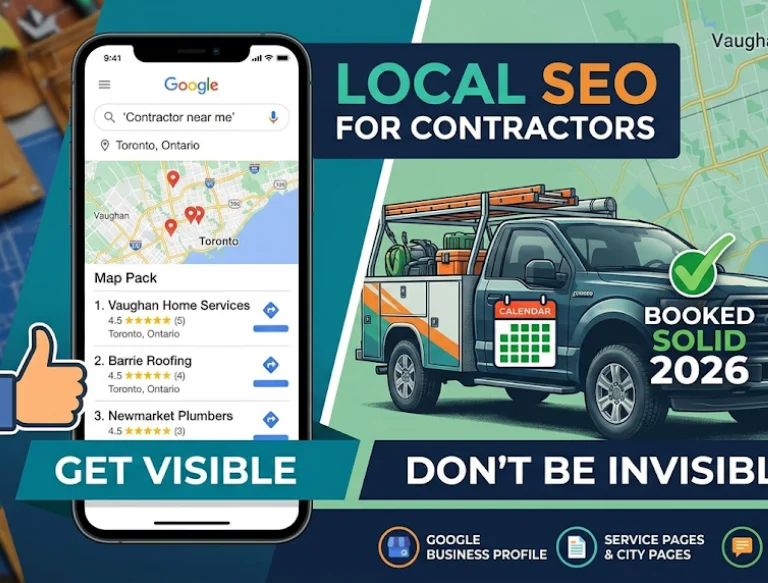
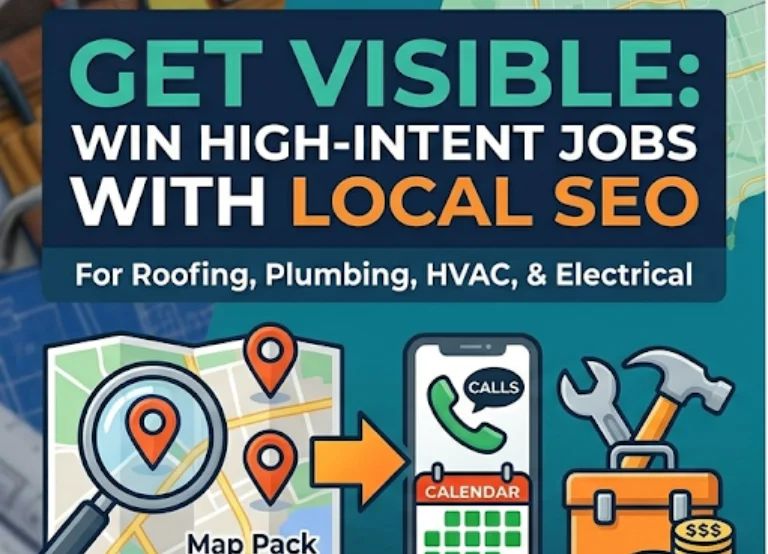
If you're a contractor relying on word-of-mouth to fill your calendar, you're leaving money on the table. Local SEO for contractors is the single most cost-effective way to win high-intent jobs in your service area — and in 2026, it's no longer optional. Homeowners and property managers search Google first. If you're not in the top three local results (the "Map Pack"), you're invisible.
The good news: local SEO is winnable for any contractor willing to do the work. This guide walks you through exactly how to rank — no jargon, no fluff, just the steps we use to get our clients to the top of local search for roofing, plumbing, HVAC, electrical, landscaping, concrete, flooring, and general contracting.
What Local SEO Actually Means for a Contractor
Local SEO is the process of making your business show up when someone nearby searches for the service you offer. For a contractor, that typically means queries like "roofer near me," "emergency plumber [city]," or "HVAC repair [zip code]." Rank in the top three results on the map and the phone rings. Rank on page two and you're effectively invisible.
Unlike national SEO — which is a long, expensive battle for broad keywords — local SEO is about proximity, relevance, and prominence. Google's local algorithm ranks businesses based on how close they are to the searcher, how well their profile matches the query, and how trusted they look across the web.
The Three Pillars of Local SEO
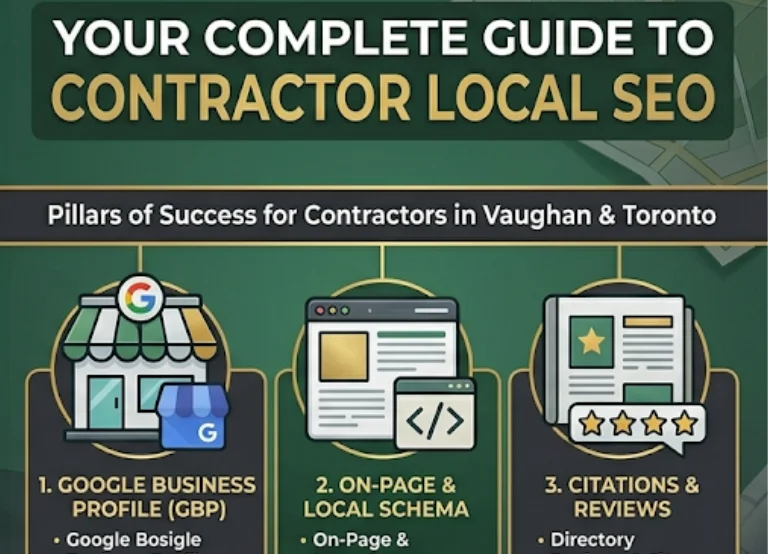
Every contractor's local strategy rests on three pillars. Neglect any one and your rankings stall.
- Google Business Profile (GBP): Your single most important local asset. This is what powers the Map Pack.
- On-page signals: Service pages, city pages, NAP consistency, and local schema markup on your website.
- Off-page trust: Citations across industry directories, backlinks from local sources, and a steady flow of recent reviews.
Optimizing Your Google Business Profile
Most contractors claim their GBP, fill in the basics, and never touch it again. That's leaving 80% of its ranking power on the table. Here's what to actually do:
- Set the right primary category. "Roofing Contractor" beats "General Contractor" for a roofer nine times out of ten. Your primary category is the single biggest ranking lever on your profile.
- Add every relevant secondary category. If you install metal roofs and do storm repair, add both.
- Define your service areas precisely. Don't list every city within 200 km — Google penalizes overreach. Stick to the areas you actively service.
- Upload at least 20 high-quality photos. Real job-site photos outperform stock imagery every time.
- Post weekly. Google rewards recency. A quick job update or offer every week signals an active business.
- Answer every review within 48 hours. Responding to reviews is a confirmed ranking factor.
- Populate the Q&A section yourself. Seed the most common questions with your own answers before competitors or strangers do it for you.
Local On-Page SEO: Service Pages and City Pages
Your website needs to back up your GBP. That means a dedicated page for every core service — and ideally, a page for every major city you serve. A plumber operating in Barrie, Newmarket, and Aurora should have a service-area page for each, not one generic "areas we serve" page.
Every page needs: a keyword-focused H1, the city name in the title tag and meta description, clear local schema markup (LocalBusiness + Service), real project photos, and genuine reviews from customers in that area. Avoid the spun-content trap — Google's helpful-content system can detect near-duplicate city pages and will suppress all of them.
"Contractors don't lose local rankings because the algorithm changed. They lose because they treated local SEO as a one-time project instead of a monthly habit."
Contruva
Citations and Reviews: Building Local Trust
Citations are mentions of your business name, address, and phone number (NAP) on third-party sites. Consistency matters more than quantity — one incorrect phone number on Yelp can quietly drag down your rankings. Start with the top contractor directories (HomeStars, Houzz, Angi, BBB, and industry-specific sites for your trade), then expand to local chamber of commerce listings and regional blogs.
Reviews carry even more weight. Google looks at volume, velocity, and recency. A contractor with 45 reviews earned over three years underperforms one with 25 reviews earned in the last six months. Build a simple system — SMS review request 24 hours after job completion — and you'll outrank competitors with twice your review count.
Common Local SEO Mistakes Contractors Make
- Using a virtual office or UPS Store address (instant ranking suppression and potential suspension).
- Stuffing keywords into the business name on GBP (e.g., "ABC Plumbing - Toronto Emergency Plumber").
- Letting the website NAP drift from the GBP NAP.
- Posting the same template review response to every review.
- Ignoring the Services section on GBP — Google uses it to understand what you offer.
How Long Does Local SEO Take to Work?
Most contractors see measurable Map Pack movement in 60–90 days when the fundamentals are solid. Reaching the top three for competitive terms typically takes 4–8 months. Contractors in less-saturated markets or specialty trades (e.g., masonry restoration, commercial HVAC) often rank faster because the competition simply isn't doing the work.
Frequently Asked Questions
Do I need a website to rank in the Map Pack?
Technically no — but in practice, yes. A Google Business Profile alone will rank for low-competition terms, but any competitor with a decent website and service pages will outrank you on anything worth ranking for.
How many reviews do I need to rank?
There's no magic number. What matters is that you match or exceed the review count of the top three competitors in your service area — and that your reviews are more recent.
Should I pay for citations or build them myself?
The top 20 citation sites are worth doing manually to ensure accuracy. Beyond that, an aggregator service is fine — just verify listings quarterly to catch any data drift.
Local SEO isn't a quick hack, but it can become a durable lead source. Contruva helps contractors keep review requests, customer follow-up, and marketing activity connected in one business platform.
Recent Posts