








Most "contractor marketing strategies" aren't strategies — they're a loose collection of tactics: some Facebook posts, a logo refresh, a lead-gen service subscription, and maybe a round of Google Ads. That's not a strategy. That's spending money and hoping.
A real contractor marketing strategy is a system. It has a foundation, an acquisition layer, a nurture layer, and a retention layer — each tuned to the economics of your specific trade. This playbook walks through the framework we use with every contractor client, plus how to set a sensible budget, what to track, and how to build a 90-day plan.

Why Most Contractor Marketing Fails
Three reasons, in almost every case: contractors pick tactics before strategy, they skip the foundation, and they don't track what's working. You can run brilliant Google Ads, but if they land on a slow, confusing website with no reviews — they'll underperform. You can have a beautiful website, but without Local SEO it won't rank. Every layer depends on the one beneath it.
The Four-Layer Contractor Marketing Framework
Every contractor marketing plan should fit into four layers, built in order:
Layer 1: Foundation
Your website and Google Business Profile. These are the two assets every other channel depends on. Before you spend a dollar on acquisition, make sure the foundation is solid: a fast, conversion-focused site; a fully optimized GBP; and basic review generation in place.
Layer 2: Acquisition
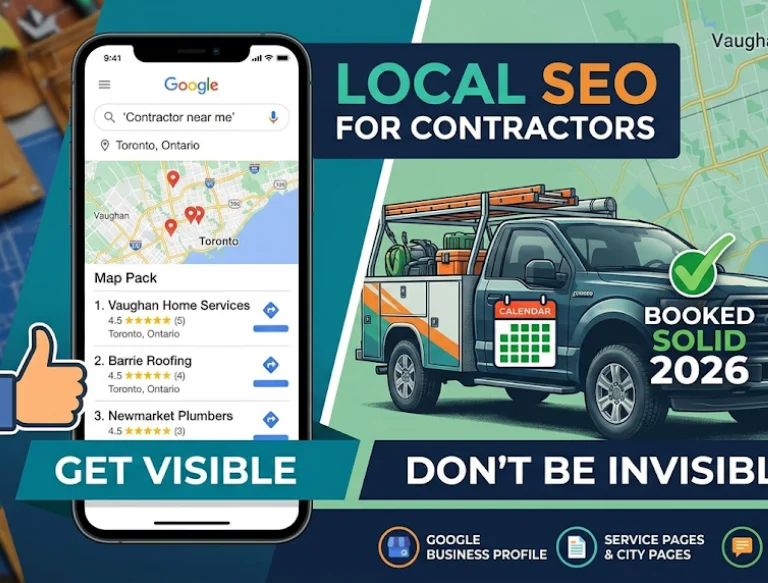
How new prospects find you. Local SEO (organic Map Pack), Local Services Ads, Google Search ads, and service-area content. Multiple channels at 60% capacity always beat one channel at 100% — it's more resilient and more sustainable.
Layer 3: Nurture
The 70–80% of prospects who don't convert on first visit. Retargeting ads, email sequences for estimate-stage leads, and remarketing to past site visitors. This is where contractor marketing is usually the weakest — and where the easiest wins are hiding.
Layer 4: Retention
Past customers are the highest-margin leads you'll ever get. Email newsletters, annual maintenance reminders, and a systematic referral program. A well-run retention layer commonly produces 30–40% of total annual revenue at near-zero acquisition cost.
Setting a Marketing Budget That Makes Sense
The common "spend 10% of revenue on marketing" rule doesn't apply cleanly to contractors because ticket sizes vary so widely. A more useful approach: work backwards from a target cost-per-booked-job (CPBJ) that still leaves you profitable.
Example: A roofer averaging $14,000 per job at a 25% close rate and a 40% gross margin can comfortably spend $500 per booked job on marketing. That's a CPBJ of $500, which translates to roughly $125 per lead (at a 25% close rate). If Google Search ads cost you $80 per lead, great. If they cost $300 per lead, the channel is losing money — regardless of volume.
"A marketing budget without a target cost-per-booked-job is just a gambling budget. Know your number before you spend a dollar."
Contruva
How to Track What's Actually Working
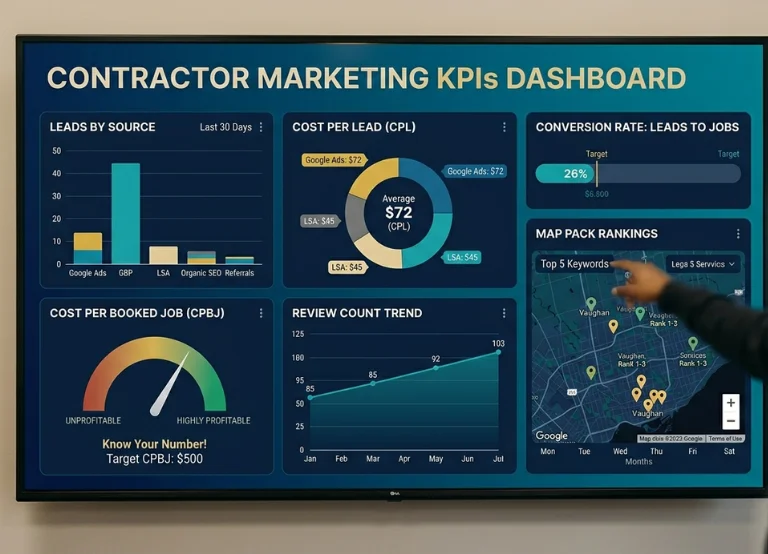
You can't optimize what you don't measure. Every contractor should track a short list of KPIs monthly:
- Leads by source: GBP, Search ads, LSA, organic, referral, direct.
- Cost per lead by channel.
- Lead-to-quote rate and quote-to-booked-job rate.
- Cost per booked job.
- Average ticket size and gross margin per job.
- Review count trend.
- Map Pack rankings for top 5 keywords.
Call tracking (CallRail, CallTrackingMetrics) is non-negotiable — most contractor leads come by phone, and without tracking you're attributing blindly.
Building a 90-Day Marketing Plan
- Days 1–30 — Foundation: Audit and optimize GBP. Fix the three biggest website conversion issues. Install call tracking. Set up a review-generation SMS workflow.
- Days 31–60 — Acquisition: Launch or restructure Google Search ads around your top three services. Enrol in LSA. Publish three new service-area content pieces.
- Days 61–90 — Nurture and Optimize: Launch retargeting. Build an estimate follow-up email sequence. Review KPIs and reallocate spend based on cost per booked job.
Ninety days gets you from reactive to systematic. The next 90 days are about refinement and expansion — not starting over.
When to DIY vs Hire an Agency
DIY makes sense if: you have a marketing-inclined team member with 10+ hours per week, your market isn't highly competitive, and your ticket size can't yet support agency fees. Hire an agency when: you're spending $3,000+/month on ads, losing competitive rankings to newer entrants, or spending more time managing marketing than running your business.
Frequently Asked Questions
How much should a contractor spend on marketing?
Typically 5–12% of revenue, higher for businesses in growth mode and lower for established shops running mostly on repeat and referral. The right answer is whatever cost-per-booked-job keeps you profitable.
What's the fastest-working marketing channel for a contractor?
Local Services Ads typically produce leads within 2–4 weeks of launch. Google Search ads are similarly fast. SEO is slower but cheaper in the long run.
Should contractors advertise on social media?
Facebook and Instagram work well for visual trades (kitchen remodelling, landscaping, custom decks) and for retargeting. They underperform for emergency-demand trades (plumbing, HVAC repair) compared to Google.
A marketing strategy is the difference between hoping and knowing. Contruva gives contractors one place to organize customers, follow-up, reviews, content, and day-to-day operations. Explore the platform or book a demo.
Recent Posts